Boilermaker jobs in Australia for South Africans: settle your occupation code before you pay TRA
Tips · 2026-10-28 · 10 min read
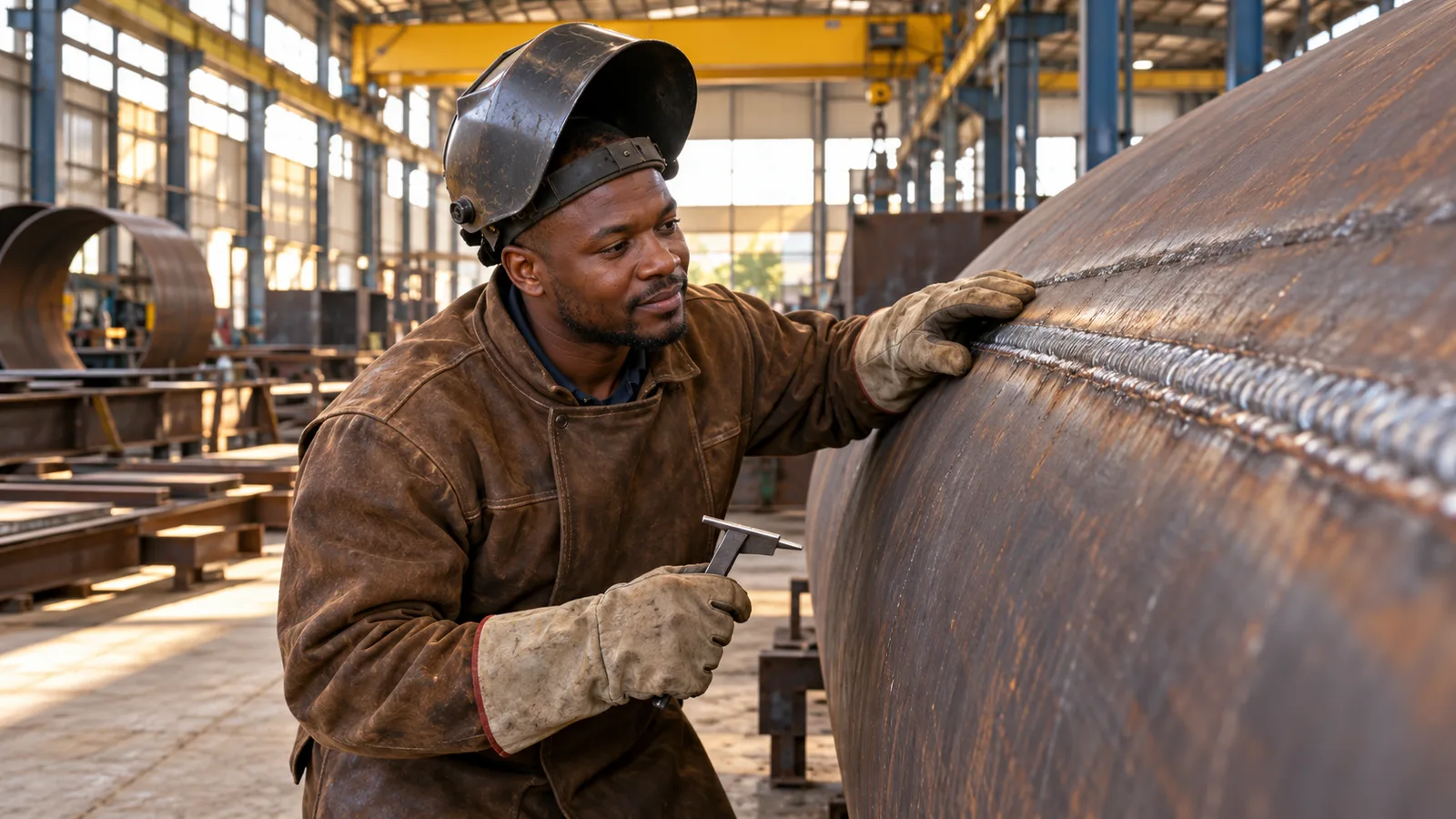
Boilermaker jobs in Australia for South Africans begin with a choice most applicants make too late: which Australian occupation your work really belongs to. On the list Trades Recognition Australia (TRA) keeps for South African passport holders, the names closest to boilermaking are Metal Fabricator [322311], Sheetmetal Trades Worker [322211], Welder (First Class) [322313] and Fitter – Welder [323213]. Work out which one your papers prove, and only then pay for a skills assessment.
Boilermaker is a workshop word; the paperwork runs on occupation codes
Ask artisans in Secunda or Vanderbijlpark what a boilermaker does and you will hear about plate, pressure vessels, structural steel and pipe spools. Australian adverts are just as loose: "boilermaker", "fabricator", "boilermaker/welder".
What matters is the single occupation your employer nominates. Your skills assessment, your visa application and your evidence must all point at that one name and code. If they do not agree, you are the one who has to explain the gap.
TRA lists South Africa as a nominated country for its Offshore Skills Assessment Program (OSAP) in all four of the metal occupations above. Check that South Africa still sits next to your code on TRA's nominated occupations and countries page on the day you apply, because lists are revised. Our guide to the offshore skills assessment program for South African tradies covers the whole trade list.
Four codes side by side: which one matches your week?
The table below gives plain pointers, not official definitions. Use it to sort your own work, then read the occupation descriptions on the official lists before you commit.
| Occupation and code | Work your letters should show | Often fits you if... |
|---|---|---|
| Metal Fabricator [322311] | Marking out, cutting, forming and joining heavy plate and sections; reading fabrication drawings; building structures, tanks and vessels | Most of your years were in a fabrication or plate shop, and welding was one tool among many |
| Sheetmetal Trades Worker [322211] | Thinner sheet: ducting, enclosures, guards, flashings, folding and rolling | Your work was mostly lighter-gauge sheet rather than heavy plate |
| Welder (First Class) [322313] | Welding as the main task, across processes and positions, often to strict procedures | You spent your days on the torch rather than on layout and assembly |
| Fitter – Welder [323213] | Mechanical fitting and repair of machinery combined with welding | You were a maintenance artisan on a plant or mine who welded as part of repairs |
Many South African boilermakers did a bit of everything, especially on shutdowns. The question is which work filled most of your hours, and which work your former employers will put in writing.
Read your work history the way an assessor will
OSAP is for skilled migration applicants who work in a nominated occupation, hold a current and valid passport from a nominated country and have relevant work experience. In practice, the assessor looks at your file, not your reputation. So before you choose a code, lay out every job you have held and ask three questions.
- What did I make or repair? Pressure vessels and structural steel point one way; ducting and enclosures point another.
- What did I spend most hours on? Layout and assembly, welding, or fitting machinery.
- What can I prove? A service letter from each employer with your title, dates, hours and duties, plus payslips for the same periods.
If a service letter says "general worker" while you were running a fabrication bay, ask for a corrected letter now, while the supervisor who knew your work is still there. A letter that names your materials, drawings and welding processes carries far more weight than one that only gives a job title.
Your trade certificate, explained in terms an Australian will follow
An Australian assessor does not know our system by heart, so describe it in official words. The South African Government describes an artisan as a skilled worker trained through a 4-year apprenticeship that combines theory at a TVET college with practical training under a mentor. The QCTO recognises you as an artisan once you have passed a trade test and been issued a trade certificate.
Many of us say "red seal", but that is an everyday name, not an official one. On your CV and forms write "trade test" and "trade certificate". For emigration you can apply directly to the QCTO for a letter of authentication; our guide to getting your QCTO letter first walks through it.
Want to see how your experience lines up with the Australian trade qualification for this work? RPLDirect's page on the Certificate III in Engineering – Fabrication Trade lists the roles it covers, from boilermaker to sheetmetal worker. It is a separate Australian qualification, not a skills assessment for your visa.
What the assessment costs, and when the clock starts
TRA says the total cost of OSAP is up to $5,320 (AUD) for Pathway 1 and $2,020 (AUD) for Pathway 2. That is roughly R60,700 and R23,050, using the official US dollar rates of 16 Oct 2026 from the Reserve Bank of Australia and the South African Reserve Bank. Rates change every day, so treat the rand figures as a guide only. Our full TRA cost guide for South Africans breaks down the rest of the bill.
Timing matters too. The registered training organisation emails the outcome approximately 15 weeks after the complete documentary evidence is submitted. An assessment with no validity period shown is valid for 3 years from the date of issue. For the Skills in Demand visa (subclass 482), a mandatory assessment must have been undertaken or commenced within the 3 years before the visa application, and it must be started before you lodge, or the application is not valid.
How your code follows you into a sponsored job
The Skills in Demand visa (subclass 482) lets an employer sponsor a suitably skilled worker for a position it cannot fill with a suitably skilled Australian. In the Core Skills stream the occupation must be on the Core Skills Occupation List (CSOL), and the pay must meet the Annual Market Salary Rate for the occupation and be no less than the Core Skills Income Threshold: AUD79,423 for nominations lodged from 1 July 2026 to 30 June 2027.
The 482 also asks for at least 1 year of relevant work experience in the occupation or a related field within the last 5 years. Confirm your code on the Home Affairs combined list of eligible skilled occupations, which shows the list an occupation sits on and its assessing authority. Our Skills in Demand (482) guide for South Africans sets out the visa steps around the assessment.
When you look at adverts, read past the title. A role such as this fabricator / welder job in Perth could be nominated under more than one code, so ask the employer which occupation they plan to use before you pay TRA. Current openings sit in our manufacturing jobs in Australia and New Zealand section.
English is the step South Africans tend to forget. The passports exempt from the 482 English test are those of Canada, New Zealand, the Republic of Ireland, the United Kingdom and the United States, so a South African passport alone does not exempt you. If you need a score, PractiseNow's IELTS and PTE practice lets you find your weak section early.
One more rule: applicants must not have asked for, offered, received or provided a benefit in return for visa sponsorship in the past 3 years. Anyone selling you a "sponsored boilermaker position" is putting your visa at risk.
New Zealand as a second option
New Zealand runs on a different system. The Accredited Employer Work Visa (AEWV) needs a job offer from an accredited employer for at least 30 hours a week, paid at least the market rate, and you must show 2 years or more of relevant experience or a qualification at level 4 or higher on the NZQCF in the same field. The visa costs from NZD $1540. Openings such as this fitter / turner and welder job in Christchurch show the mixed metal roles employers there advertise.
Boilermakers from other countries are weighing the same choices. JobsAbroad Indonesia's practical look at Australia's welder shortage for fabricators and boilermakers covers the demand side.
Choosing your code, step by step
- List every job since your apprenticeship, with dates and the main work you did in each.
- Match that work to the four codes in the table, and mark the one that covers most of your hours.
- Read that occupation on the Home Affairs combined list and check South Africa against it on TRA's page.
- Collect service letters and payslips that describe the same work in the same words, and get your QCTO letter of authentication.
- Rewrite your CV around that occupation; a tool like Build AI CV helps you lay out duties, materials and processes clearly.
- When an employer shows interest, confirm the occupation they will nominate before you pay for OSAP.
Our look at Australia's 2026 welding industry survey for boilermakers and welders shows where the demand is, and the fitter and turner guide helps if your work leans towards Fitter – Welder.
Common mistakes boilermakers make when picking a code
- Copying the advert title. "Boilermaker" on an advert does not tell you the occupation the employer will nominate. Ask.
- Choosing the code with the best-sounding name. Welder (First Class) sounds senior, but if your letters describe layout and assembly, Metal Fabricator may be the honest fit.
- Thin service letters. A title and dates are not enough. Describe the materials, drawings and processes you worked with.
- Paying before the job is clear. An assessment in the wrong occupation is money and weeks lost.
- Paying someone for a sponsorship. The Department of Employment and Labour says that as soon as you are asked to pay for recruitment, it is likely to be a scam.
Frequently asked questions
Is boilermaker on TRA's list for South Africans?
TRA's South African OSAP list names Metal Fabricator, Sheetmetal Trades Worker, Welder (First Class) and Fitter – Welder among its trades. Boilermaking work usually sits under one of those, depending on what your service letters show.
Should a South African boilermaker apply as Metal Fabricator or Welder (First Class)?
Apply under the occupation your evidence proves. If most of your hours went into layout, forming and assembly, Metal Fabricator is often closer; if welding itself filled your days, Welder (First Class) may fit better. Confirm with your employer before paying.
How much does a TRA skills assessment cost for a boilermaker from South Africa?
TRA says OSAP costs up to $5,320 (AUD) for Pathway 1 and $2,020 (AUD) for Pathway 2, roughly R60,700 and R23,050 at the official US dollar rates of 16 Oct 2026. Exchange rates change, so check before you budget.
Do South African boilermakers need an English test for the 482 visa?
A South African passport is not on the list of exempt passports, so most applicants need a test result. There is an exemption for people who completed at least 5 years of full-time study at a secondary or higher institution where most classes were in English.
How long is a TRA assessment valid?
An assessment with no validity period shown is valid for 3 years from the date of issue. For the 482, a mandatory assessment must be undertaken or commenced within the 3 years before you apply for the visa.
Key takeaways
- "Boilermaker" is a workshop word; your visa runs on one occupation code.
- Four metal codes on TRA's South African list are worth comparing before you pay.
- Choose the code your service letters and payslips prove.
- OSAP costs up to $5,320 (AUD) and takes about 15 weeks from complete evidence.
- Ask the employer which occupation they will nominate before you start.
#boilermaker #metal fabricator #skills assessment #osap #welding jobs #south africa
 Fitter and turner jobs in Australia for South Africans: three codes, and only one fits your work
 Diesel mechanic jobs in Australia for South Africans: your trade is listed, your paperwork decides
 Offshore skills assessment program for South African tradies: is your trade on TRA's list?